
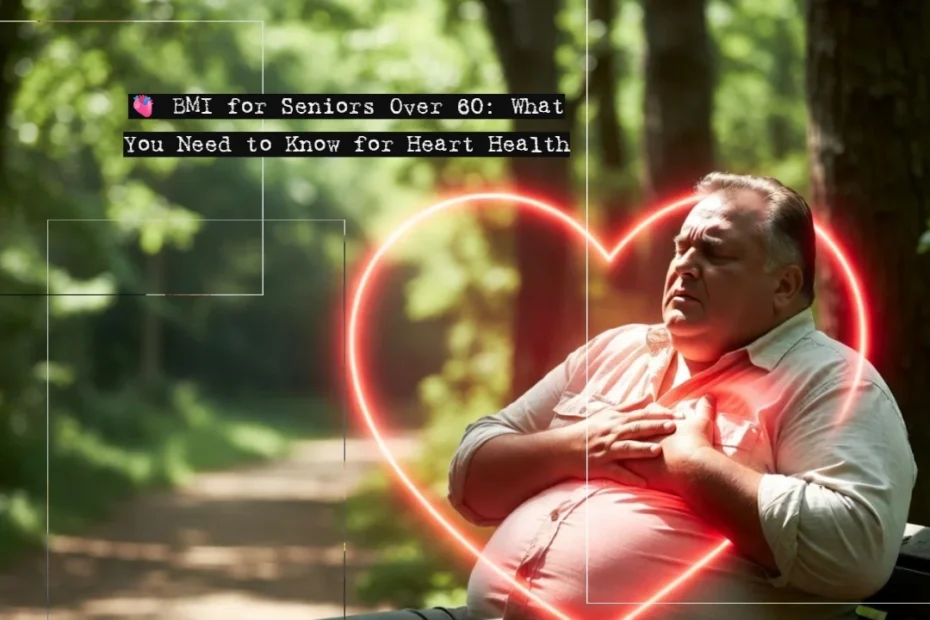
The Body Mass Index (BMI) measures body fat based on your weight and height. But for adults over 60, BMI alone doesn't tell the full story. As we age, we lose muscle mass and bone density – a senior with a "healthy" BMI of 22 may actually have too little muscle and too much dangerous belly fat.
Table of Contents
ToggleResearch suggests that a BMI of 23–27 may be associated with better health outcomes for adults over 65 than the standard 18.5–24.9 range. Waist circumference and muscle mass matter more than BMI alone.
🫀 BMI for Seniors Over 60: What You Need to Know for Heart Health
Understanding weight, body fat, and heart disease risk after age 60
🌿 Wellness & Educational Purpose Only
This site is for wellness and educational purposes only. It is not a medical website and
does not provide medical advice, diagnosis, or treatment. The information presented here is not a substitute for
professional medical advice. Always consult your doctor or qualified healthcare provider before making any changes
to your diet, exercise, or health routine, especially if you have existing medical conditions or take medications.
📊 BMI for Seniors Over 60 - Calculator
Enter your height and weight to calculate your BMI
📋 BMI for Seniors Over 60 Classification
| BMI Range | Classification | What It Means for Seniors |
|---|---|---|
| Below 18.5 | Underweight | ⚠️ May indicate muscle loss – talk to your doctor |
| 18.5 – 22.9 | Normal (Standard) | ✅ Generally healthy, but check waist circumference |
| 23.0 – 26.9 | Healthy for Seniors ✓ | ✅ Often ideal for adults over 65 |
| 27.0 – 29.9 | Overweight | ⚠️ Monitor waist circumference |
| 30.0 – 39.9 | Obese | ⚠️ Increased heart disease risk |
| 40 and above | Morbidly Obese | 🚨 Seek medical guidance |
📏 Waist Circumference: A Better Measure for Seniors
📐 How to Measure
- Stand straight, breathe out normally
- Measure at belly button level
- Tape snug, not compressing skin
⚠️ Healthy Limits
👩 Women: Less than 35 inches (88 cm)
👨 Men: Less than 40 inches (102 cm)
❤️ Heart Health Tips for Managing Weight After 60
🚶♂️ How Low-Impact Fitness Affects Heart Health for Seniors
You don't need to run marathons to protect your heart – gentle movement works wonders
For seniors, the word "exercise" can sound intimidating. But here's the good news: low-impact fitness – activities that are gentle on your joints – can transform your heart health without the risk of injury. Even if your BMI is above the ideal range, regular low-impact movement directly improves cardiovascular function, lowers blood pressure, and reduces inflammation.
❤️ How Low-Impact Fitness Helps Your Heart
- 💓 Lowers resting heart rate – Your heart pumps more efficiently with regular movement
- 🩸 Reduces blood pressure – Just 20 minutes of walking daily can lower systolic BP by 5-10 points
- 🔥 Decreases inflammation – Chronic inflammation is a root cause of heart disease
- 📉 Improves cholesterol – Raises "good" HDL and lowers triglycerides
- ⚖️ Aids weight management – Complements BMI improvement without joint stress
🏊 Best Low-Impact Activities for Seniors
- 🚶♂️ Brisk Walking – 20-30 minutes daily. No equipment needed.
- 🏊 Swimming or Water Aerobics – Zero joint impact, excellent for arthritis
- 🚴 Stationary Cycling – Strengthens legs and heart while seated
- 🧘 Chair Yoga or Tai Chi – Improves balance, flexibility, and circulation
- 💪 Resistance Bands – Builds muscle mass (critical for metabolism and heart health)
• Always consult your doctor before starting a new exercise routine, especially if you have heart conditions
• Start with 5-10 minutes daily and gradually increase by 2-3 minutes each week
• Listen to your body – mild warmth is normal, sharp pain means stop
• Stay hydrated – drink water before, during, and after activity
• Wear supportive, non-slip shoes to prevent falls
📅 Sample Weekly Low-Impact Activity Plan for Seniors
| Day | Activity | Duration | Heart Health Benefit |
|---|---|---|---|
| Monday | Brisk outdoor walk | 15 minutes | Lowers blood pressure |
| Tuesday | Chair yoga + stretching | 20 minutes | Reduces stress, improves circulation |
| Wednesday | Swimming or water aerobics | 20 minutes | Strengthens heart muscle |
| Thursday | Resistance band exercises | 15 minutes | Builds muscle, boosts metabolism |
| Friday | Tai chi or gentle stretching | 15 minutes | Improves balance, lowers fall risk |
| Saturday | Stationary cycling | 20 minutes | Cardiovascular endurance |
| Sunday | Rest or gentle walk | 10 minutes | Active recovery |
❤️ Remember: Any movement is better than none. Start where you are, use what you have, do what you can. Your heart will thank you for every step you take.
❓ Frequently Asked Questions - BMI for seniors over 60
Answers to common questions about BMI, heart health, and safe exercise for seniors
What is a healthy BMI for a 75 year old woman?
▼A healthy BMI for a 75-year-old woman is typically 23 to 27. This range is slightly higher than the standard 18.5–24.9 because older adults benefit from having a bit more body mass to protect against muscle loss (sarcopenia) and bone density reduction. Research shows that seniors in the 23–27 BMI range have lower mortality rates than those in the "normal" 18.5–22.9 range.
How can seniors improve heart health without running?
▼Seniors can improve heart health with low-impact activities that are gentle on joints. Here are 5 effective options:
- 🚶♂️ Brisk Walking (20-30 minutes daily) – Lowers blood pressure and improves circulation
- 🏊 Swimming or Water Aerobics – Zero joint impact, excellent for arthritis
- 🚴 Stationary Cycling – Strengthens heart muscle while seated
- 🧘 Tai Chi or Chair Yoga – Reduces stress and improves balance
- 💪 Resistance Band Exercises – Builds muscle, which supports metabolism and heart function
Is BMI accurate for older adults?
▼Not completely. BMI is a useful screening tool, but it has limitations for seniors.
✅ What BMI does well: Identifies underweight (risky for frailty) and severely obese categories.
❌ What BMI misses: It doesn't distinguish between muscle and fat. A senior with low muscle mass (sarcopenia) can have a "healthy" BMI but dangerous levels of body fat. It also doesn't account for fat distribution – belly fat (visceral) is more dangerous than fat elsewhere.
📏 Better approach for seniors: Combine BMI with waist circumference (women <35″, men <40″) and muscle strength assessment.
What exercises are safe for seniors with high blood pressure?
▼Seniors with high blood pressure should focus on moderate, steady-state activities that avoid sudden spikes in blood pressure. Safe options include:
- 🚶♂️ Walking – 20-30 minutes at a conversational pace
- 🏊 Swimming – The water's pressure naturally supports circulation
- 🚴 Recumbent or Stationary Cycling – Seated position reduces strain
- 🧘 Chair Yoga – Avoids inverted poses (head below heart)
- 🫁 Breathing Exercises – Deep, slow breathing can lower BP in the moment
How much should a 70 year old weigh?
▼There is no single ideal weight for all 70-year-olds because height, gender, and muscle mass vary. However, using the healthy BMI range for seniors (23–27), here are example weight ranges by height:
| Height | Women (23–27 BMI) | Men (23–27 BMI) |
|---|---|---|
| 5'0" (152 cm) | 117–137 lbs | 117–137 lbs |
| 5'4" (163 cm) | 134–157 lbs | 134–157 lbs |
| 5'8" (173 cm) | 151–177 lbs | 151–177 lbs |
| 6'0" (183 cm) | 170–200 lbs | 170–200 lbs |
Can low impact exercise reverse heart disease in seniors?
▼Yes, it can significantly improve heart health, but "reverse" depends on the severity.
Regular low-impact exercise has been shown to:
- ✅ Lower blood pressure by 5-10 mmHg
- ✅ Improve cholesterol (raise HDL "good" cholesterol, lower triglycerides)
- ✅ Reduce arterial stiffness – a key factor in heart disease
- ✅ Decrease inflammation markers like C-reactive protein
- ✅ Improve endothelial function (how blood vessels expand and contract)
For seniors with established heart disease, cardiac rehabilitation programs that include low-impact walking are standard treatment. While existing artery blockages may not fully disappear, lifestyle changes can stop progression and reduce symptoms dramatically.
What is the best exercise for seniors with arthritis AND heart disease?
▼🏊 Swimming and water aerobics are the best choices for seniors with both arthritis and heart disease.
Why it's ideal:
- 💧 Buoyancy reduces joint stress by 50-90% – perfect for arthritic knees, hips, and hands
- 💧 Water pressure (hydrostatic pressure) naturally supports circulation and can help lower blood pressure
- 💧 Resistance strengthens muscles without weights
- 💧 Temperature – warm water (84-88°F) relaxes stiff joints
Second-best option: Recumbent stationary cycling – seated position supports the back, reduces joint impact, and provides steady cardiovascular training.
How to maintain muscle mass after 60 for heart health?
▼Maintaining muscle mass after 60 is critical because muscles are metabolic engines that support heart health. Here are 5 key strategies:
- 🍗 Eat adequate protein: Aim for 1.0–1.2 grams per kg of body weight daily (e.g., 68–82g for a 150lb senior). Spread across 3 meals (25-30g per meal).
- 🏋️ Strength train 2-3 times weekly: Bodyweight squats, resistance bands, or light hand weights (1-5 lbs).
- ⚡ Focus on compound movements: Exercises that work multiple joints – sit-to-stand, step-ups, wall push-ups.
- 🔄 Stay consistent: Muscle loss speeds up after 60. Two weeks of inactivity can trigger measurable sarcopenia.
- 💤 Prioritize sleep: Growth hormone (essential for muscle repair) is released during deep sleep. Aim for 7-8 hours.
📝 Summary – BMI for Seniors Over 60
Understanding BMI for seniors over 60 is more nuanced than standard charts suggest. While traditional BMI guidelines consider 18.5–24.9 as “normal,” research shows that a healthy BMI for seniors over 60 actually falls between 23 and 27. This slightly higher range helps protect against muscle loss (sarcopenia), frailty, and falls – all major concerns for older adults.
So, what is a good BMI for a 70-year-old? For most seniors, a BMI of 23–27 combined with a healthy waist circumference (under 35 inches for women, under 40 inches for men) is ideal. This range supports heart health, maintains mobility, and is associated with lower mortality rates than the standard “normal” range.
However, BMI for seniors over 60 is not the whole picture. It doesn’t distinguish between muscle and fat. That’s why a healthy BMI for seniors over 60 should be paired with regular low-impact exercise (walking, swimming, tai chi) and protein-rich nutrition to preserve muscle mass. Always consult your doctor before making changes to your diet or exercise routine – and remember, movement matters more than the number on the scale.


Senior Nutrition Tips
Get daily recipes, superfood guides, and nutrition strategies designed for energy, strength, and healthy aging.
Join Our Facebook Community
Connect with others, discover daily senior wellness tips, fitness ideas, and healthy recipes to stay active and independent.
Fitness & Healthy Aging
Explore low-impact workouts, balance exercises, and strength routines to improve mobility and independence.


Take control of your heart health by managing your BMI. Discover why maintaining a healthy BMI is crucial for your heart and how to achieve it.
The key to maintaining a healthy BMI is to make sustainable lifestyle changes. This includes eating a healthy diet, getting regular exercise, managing stress, and getting enough sleep. It’s not about perfection, but progress. Every small step you take towards a healthier lifestyle counts!
Es impresionante cómo la conexión entre la obesidad, el IMC y la salud del corazón es tan estrecha y compleja. Agradezco mucho la información detallada y los consejos prácticos para cuidar de nuestro corazón a través de una mejor nutrición y ejercicio.
Understanding your BMI is a crucial step in maintaining a healthy heart! It’s great to see more awareness being raised about this important aspect of overall health.
It’s important to remember that weight loss is a journey, not a race. Small steps can lead to big changes. Focus on making sustainable lifestyle modifications, and celebrate your successes, no matter how small